[2] T.C. Schneirla (1944) "A unique case of circular milling in ants, considered in relation to trail following and the general problem of orientation," American Museum Novitates, 1253:1–26.
[3] S. Milgram(1963) "Behavioral Study of Obedience," Journal of Abnormal and Social Psychology 67: 371–378.
[8] C. W. Reynolds (1987) "Flocks, herds and schools: A distributed behavioral model, " Proc. of the 14th annual con-ference on Computer graphics and interactive techniques, ACM Press, pp. 25–34.
[9] C. W. Reynolds (1999) "Steering behaviors for autonomous characters," Proc. of Game Developers Conference.
[11] M. Ballerini, N. Cabibbo, R. Candelier, A. Cavagna, E. Cisbani, I. Giardina, V. Lecomte, A. Orlandi, G. Parisi, A. Procaccini, M. Viale and V. Zdravkovic (2007) "Interaction ruling animal collective behavior depends on topological rather than metric distance: Evidence from a field study," Proceedings of the National Academy of Sciences of the United States of America.
T.C. Schneirla (1944) "A unique case of circular milling in ants, considered in rela-tion to trail following and the general prob-lem of orientation," American Museum No-vitates, 1253:1–26.
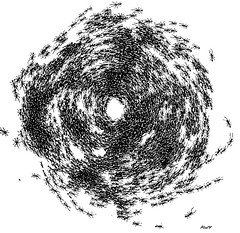
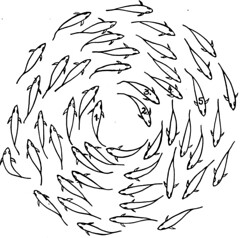
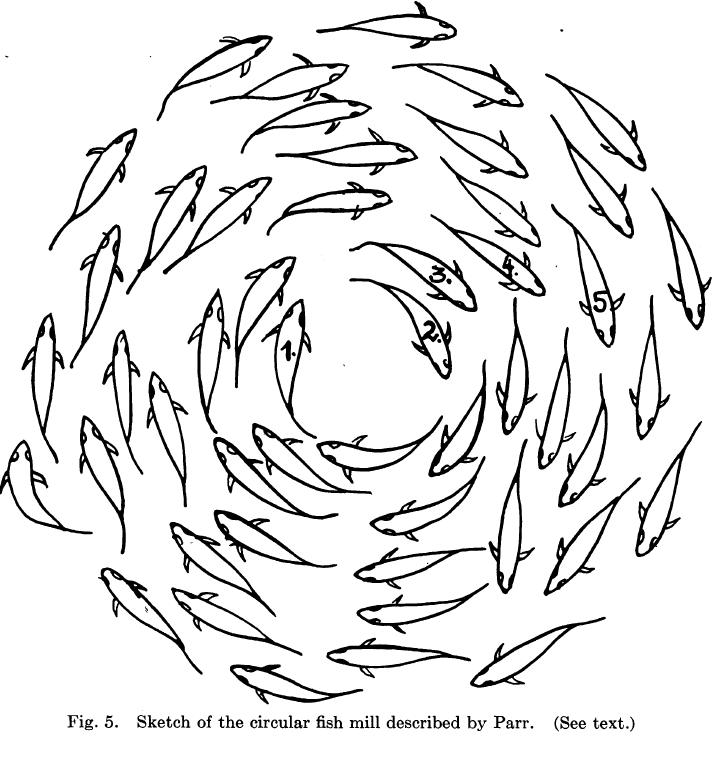
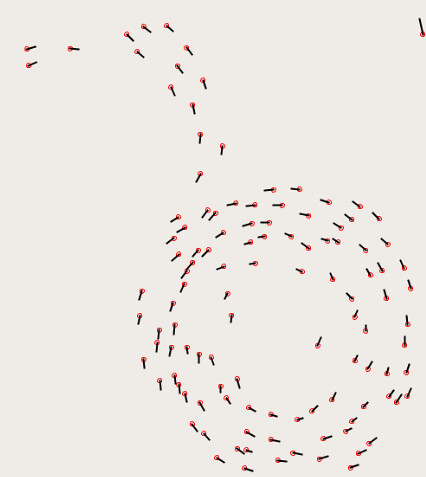
後來不小心在《The Wisdom of Crowds》這本書中得知有Circular Mill這生物現象, 而且書上的描述跟我的模擬現象相當吻和,於是進一步找到下面這篇paper,
T.C. Schneirla (1944) "A unique case of circular milling in ants, considered in rela-tion to trail following and the general prob-lem of orientation," American Museum No-vitates, 1253:1–26.
Reference: [1] T.C. Schneirla (1944) "A unique case of circular milling in ants, considered in rela-tion to trail following and the general prob-lem of orientation," American Museum No-vitates, 1253:1–26.
[2] J. Surowiecki (2004) The Wisdom of Crowds: Why the Many Are Smarter Than the Few and How Collective Wisdom Shapes Busi-ness, Economies, Societies and Nations Lit-tle, Brown ISBN 0-316-86173-1